

What is a semantic layer for market data?
As Generative AI and Large Language Models (LLMs) transition from conversational interfaces to autonomous execution agents in financial markets, they hit a critical bottleneck: raw financial data is inherently messy, fragmented, and devoid of standardized context. When autonomous agents attempt to consume uncurated time-series or unstructured feeds, the result is predictable—astronomical token burn, context-window exhaustion, and dangerous factual fabrications ("hallucinations").
To make AI reliable for institutional finance, LLMs require three core architectural pillars:
A consistent, unified API model. The same call shape for every dataset, whether it is a tick, a filing or a country forecast.
An intrinsic ontology and semantic layer. Entities and relationships rather than isolated tables, so an agent can ask by meaning.
viaNexus builds all three in at onboarding, before an agent ever sees the data.
At viaNexus, we built these requirements directly into the core platform architecture. By automatically organizing and semantically enriching any dataset upon onboarding, viaNexus provides an AI-ready data infrastructure that eliminates hallucinations, enables conceptual search, and natively resolves complex financial data anomalies such as temporal symbology overlap.
Why do financial LLMs hallucinate on market data?
Standard LLM architectures struggle with financial market data for three primary reasons:
| Where LLMs fail | Why | What the semantic layer does |
|---|---|---|
| In-context math and uncurated data | Models compute VWAP, moving averages and corporate action adjustments inside the context window. | Analytics are normalized and pre-calculated on the platform, so the model reads a number instead of deriving one. |
| Token burn and MCP spaghetti | Raw, un-normalized endpoints push agents into polling loops and large context ingestion. | One unified API model and one MCP server, so a question costs a call rather than a crawl. |
| Contextual confusion and symbology misalignment | When tickers change hands, merge or are reissued, traditional systems mix history across unrelated entities. | A temporally embedded knowledge graph binds each symbol to the right entity for the right dates. |
By anchoring LLMs to normalized, pre-calculated analytics served through an intrinsic Semantic Layer, viaNexus eliminates the need for models to perform math in-context or guess entity relationships, effectively preventing hallucinations before they happen.
What happens when a dataset is onboarded?
In traditional architectures, establishing relationships across disparate datasets requires months of manual schema design and complex ETL pipelines.
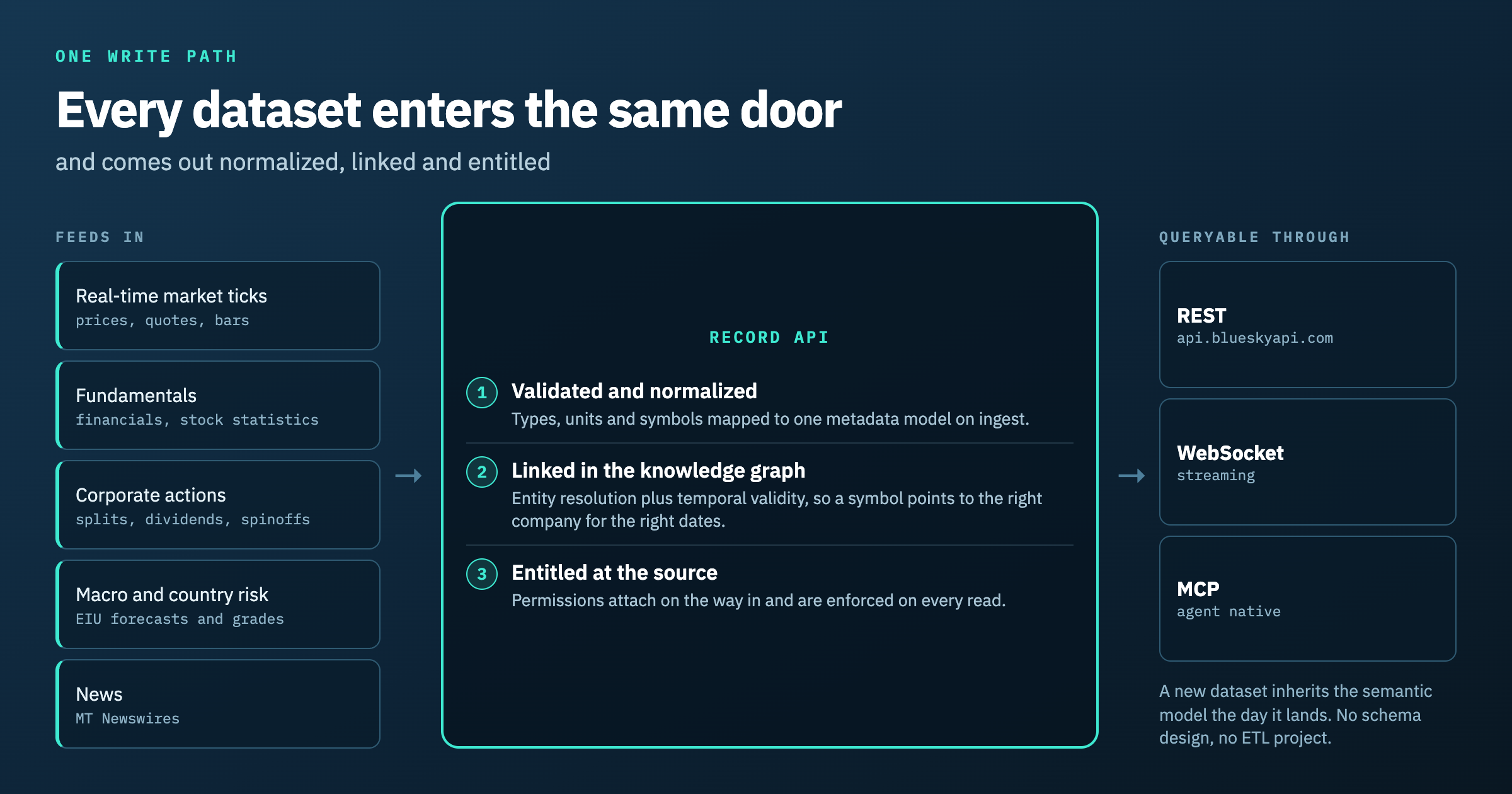
On the viaNexus platform, every dataset—whether real-time streaming market ticks, corporate fundamentals, or alternative macro data—enters through a single, unified write path (the Record API). Upon ingestion:
- Data is automatically validated, normalized, and mapped to a standardized metadata framework.
- An intrinsic Knowledge Graph Service builds entity relationships based on intent and temporal validity.
- Data is made immediately queryable across consistent REST, WebSocket, and agent-native (MCP) interfaces.
This feed-agnostic architecture ensures that any new dataset automatically inherits the platform's semantic model and entitlement controls the moment it is onboarded.
How can an agent search by meaning instead of schema?
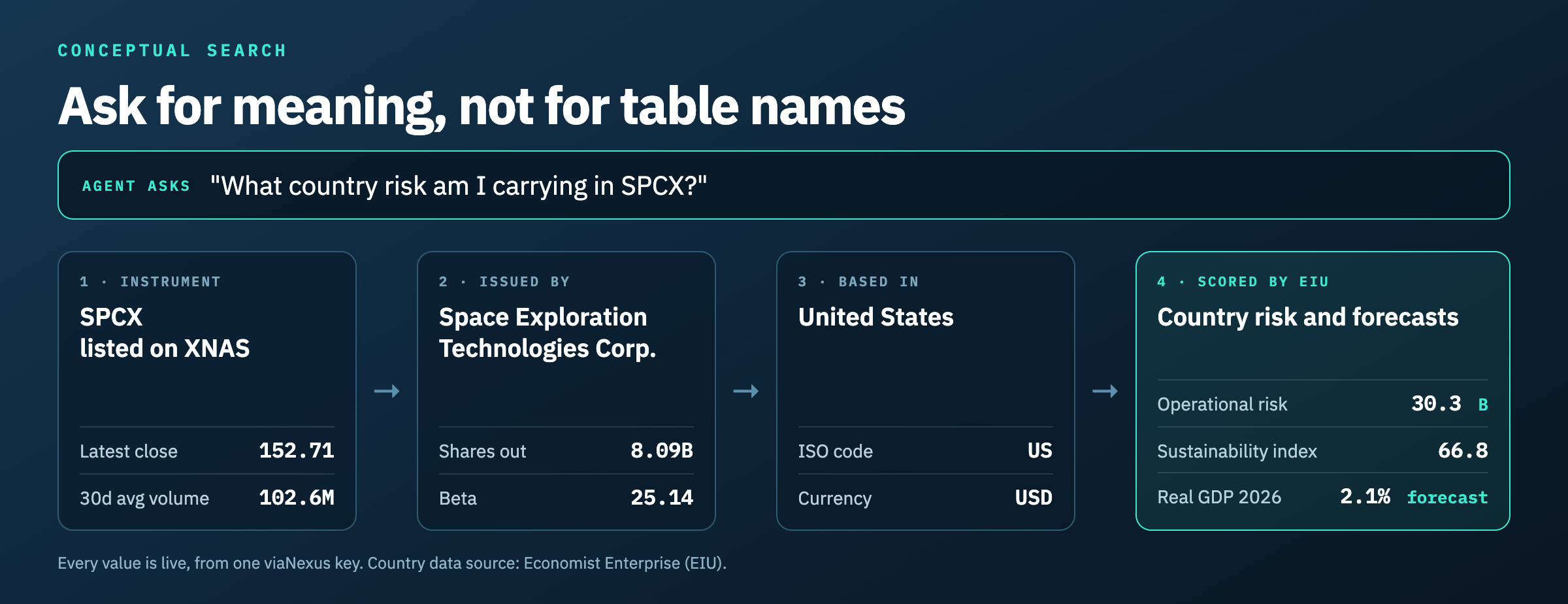
A major breakthrough of an ontology-driven platform is the shift from rigid string matching to conceptual search.
In an ontological view, data is not stored as isolated tables; it is structured as interconnected nodes representing financial entities, instruments, market events, and macroeconomic indicators. When an AI agent or quantitative model queries viaNexus, it does not need to know venue-specific internal codes or exact schema definitions. Instead, it can perform conceptual queries (e.g., "Retrieve capital structure and country risk factors for entities impacted by recent supply chain shifts"). The viaNexus platform resolves the conceptual query across underlying ontologies, retrieving precisely entitled, relevant data without unnecessary noise.
What happens when two companies share one ticker?
The necessity of temporal semantics is perfectly illustrated by a common financial data nightmare: Temporal Symbology Reuse.
How does ticker reuse corrupt a time series?
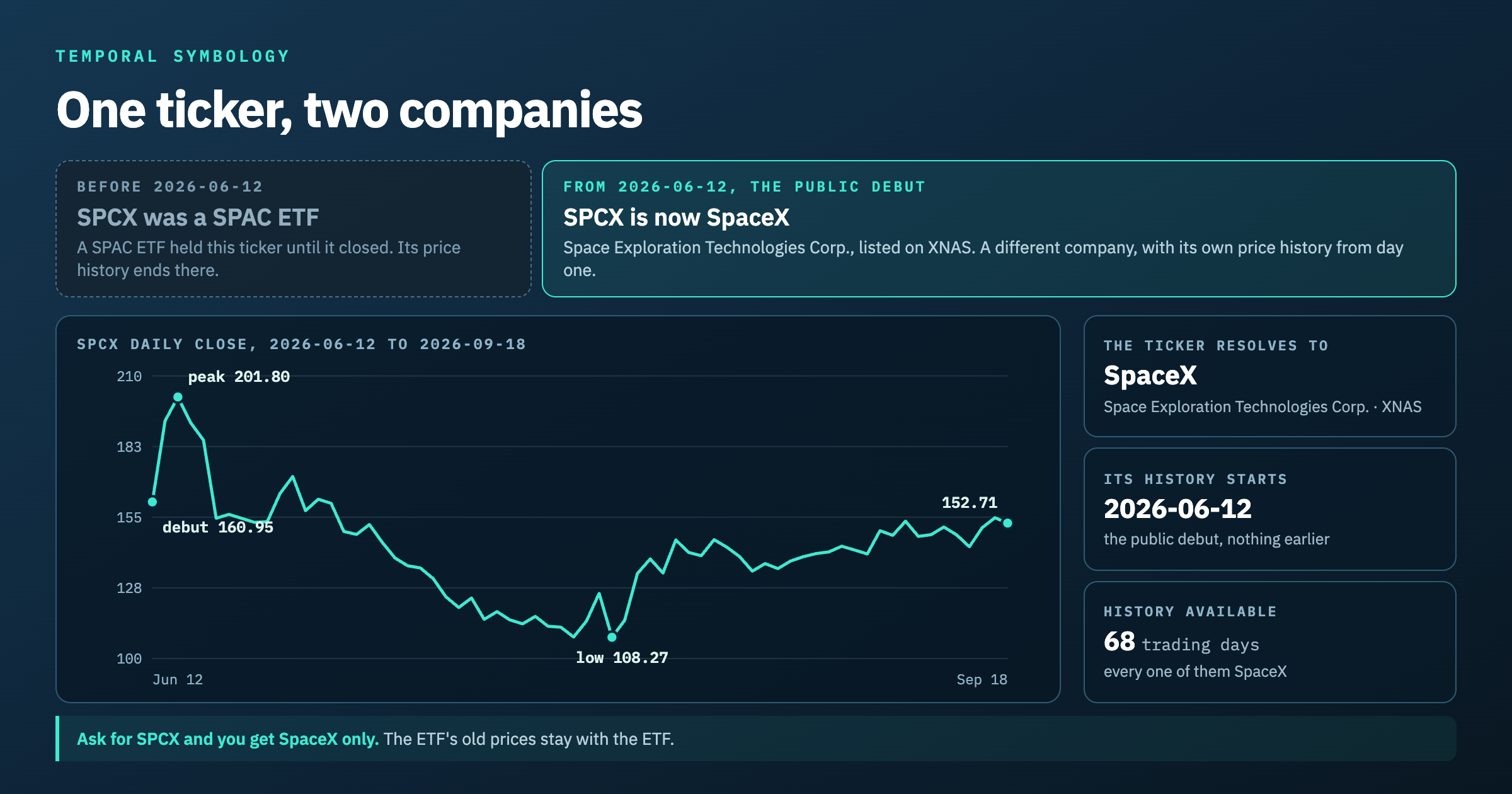
When SpaceX recently went public, the ticker symbol SPCX was assigned to the company. However, prior to the SpaceX IPO, the symbol SPCX belonged to a completely separate Special Purpose Acquisition Company (SPAC) ETF.
On the day of the SpaceX IPO, legacy data providers and standard financial APIs experienced severe data pollution:
- Historical pricing, trade history, and volatility metrics from the former ETF were erroneously blended into the new SpaceX IPO time-series.
- AI models relying on ticker lookups ingested the ETF's historical data, leading to completely hallucinated valuations, incorrect historical beta calculations, and invalid trading signals for SpaceX.
How does a temporal knowledge graph fix it?
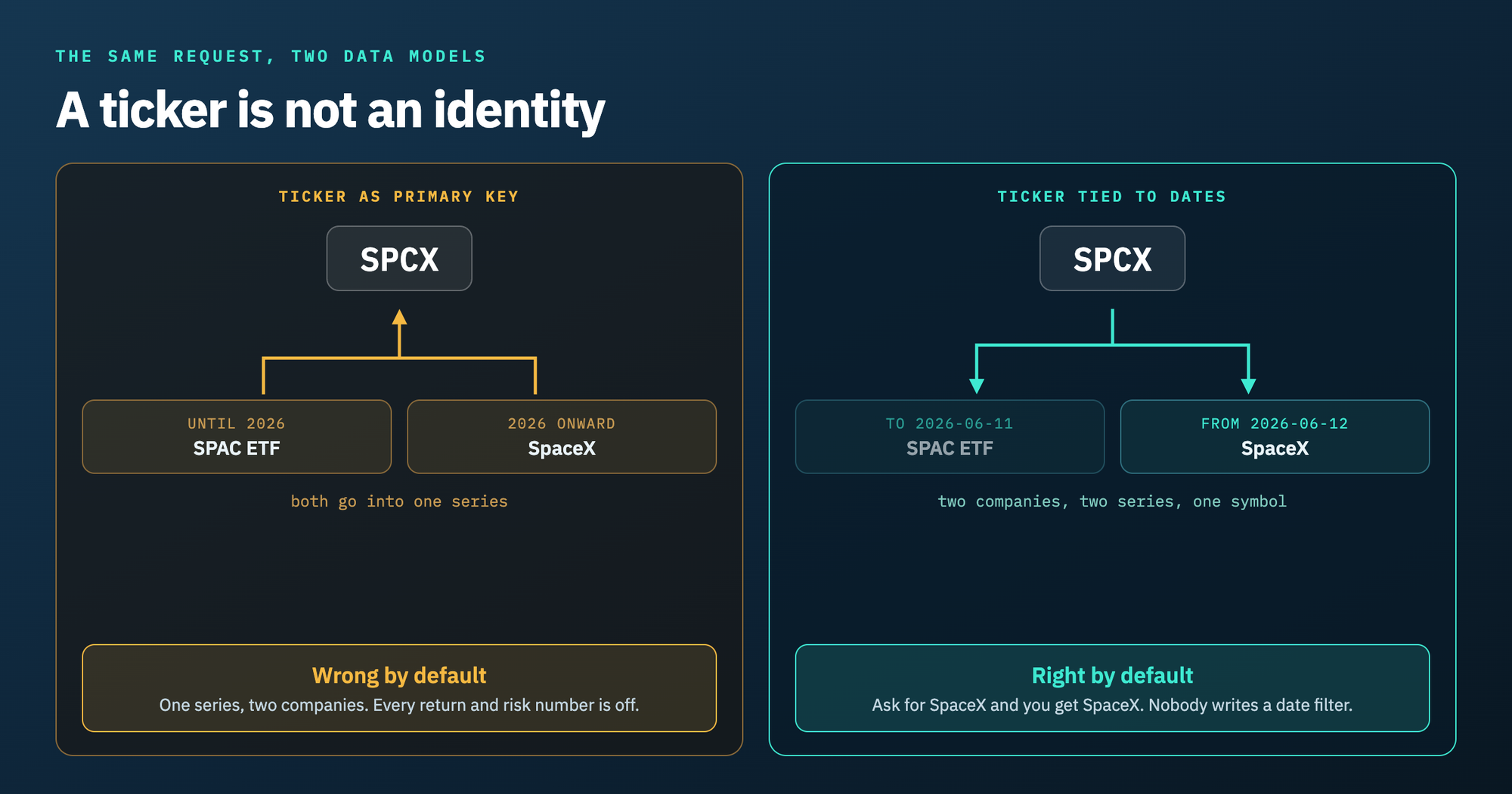
viaNexus natively prevents this through its Temporally Embedded Knowledge Graph. Rather than treating ticker symbols as static primary keys, viaNexus models the temporal evolution of a symbol:
- Canonical Entity Resolution: Each instrument and entity receives a distinct digital fingerprint, derived from its intricate web of interconnected relationships.
- Defined Lifespan Boundaries: The ticker symbol SPCX maintains a distinct relational network tied to Entity A (the SPAC ETF) prior to its liquidating closure, and transitions to map exclusively to Entity B (SpaceX) effective from its public debut date forward.
- Intent-Based Relationship Building: When an LLM or user requests historical data for SpaceX (SPCX), the Knowledge Graph enforces temporal boundaries, ensuring historical ETF data is strictly segregated from SpaceX's time-series.
By implementing true temporal semantics, viaNexus guarantees data integrity across corporate actions, ticker changes, and IPO re-assignments.
How does macro data fit alongside market data?
The power of an intrinsic ontology layer extends far beyond traditional equities and time-series financial spectrums. Because viaNexus builds proper semantics across ontologies, it seamlessly bridges market data with alternative, geopolitical, and global macroeconomic datasets.
A prime example is our partnership with EIU (Economist Intelligence Unit). EIU's world-leading macroeconomic country forecasts, operational risk indicators, business environment rankings, and sustainability indices are now fully productized and discoverable within the viaNexus Financial Data Marketplace:
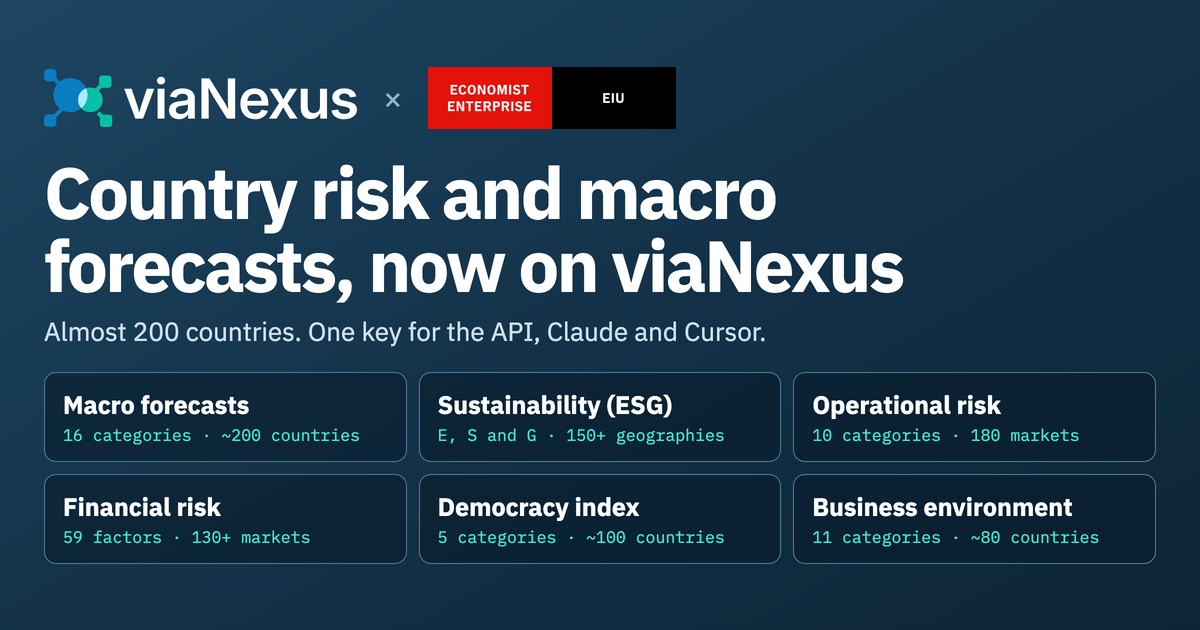
Explore the EIU Country Macroeconomics Reference Dataset:viaNexus EIU Macro Economics Reference Documentation
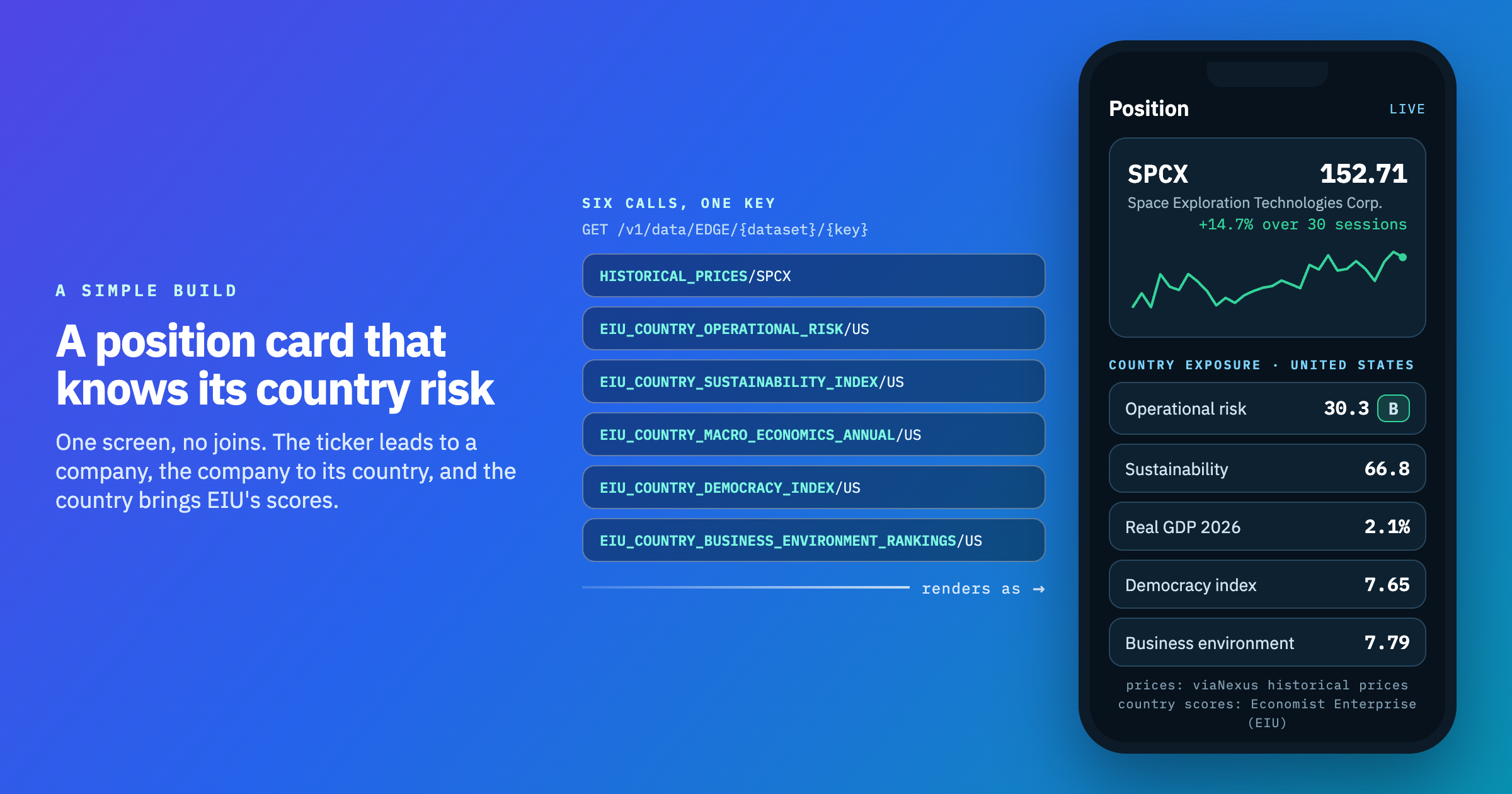
By linking EIU's macroeconomic intelligence into the viaNexus Knowledge Graph, AI agents can cross-reference sovereign risk scores, GDP forecasts, and geopolitical indicators directly alongside company fundamentals and real-time market feeds in a single, semantically connected workflow.
What does AI-ready market data infrastructure require?
AI will only transform capital markets if the underlying data layer is purpose-built for machine consumption. By combining:
- Strict data modeling and consistent APIs
- A Temporally Embedded Knowledge Graph
- Native Model Context Protocol (MCP) and agentic entitlements
...viaNexus eliminates LLM hallucinations, solves complex temporal symbology challenges, and unleashes the full potential of autonomous AI workflows in finance.
Whether you are an exchange looking to modernize distribution, a hedge fund building agentic trading pods, or a data provider seeking friction-free monetization, viaNexus delivers the AI-ready infrastructure required for the future of capital markets.
The connector is listed in the Claude directory and the Cursor plugin directory, and every dataset in this post is documented in the viaNexus catalog.