vAST
viaNexus Agentic Service Technology
vAST is the agent-ready access layer for viaNexus financial data. It connects MCP clients, Financial Chat Agent, and SDK workflows to 30+ institutional datasets through one signed credential, with server-side dataset permissions built in.
one platform · every dataset · any agent
Works with leading LLM providers
 Gemini
 Claude
 ChatGPT
MCP service
MCP
service.
Add viaNexus from the connector directory in Claude or Cursor, or point your own app at the endpoint. The agent gets search and fetch wired to your subscribed datasets.
Quickstart
There is one MCP endpoint. Authenticate once with your viaNexus account, and the MCP server exposes every dataset included in your subscription.
Where to add it
https://vast.blueskyapi.com/vianexus/mcp
One endpoint · every client below
Claude
Search viaNexus in connectors, hit Connect, sign in. Nothing to paste.

Cursor
Uses an API key, not OAuth. Install from the directory, or add the config in the setup section below.
ChatGPT
Same endpoint, same datasets. MCP support for the OpenAI platform is in active development.
Zed, and any other MCP client
Anything that speaks MCP. Point it at the endpoint above, handle OAuth in its connector config.
No account yet? The OAuth popup lets you sign up and start a trial inline. Hitting issues? Reach out to us.
Cursor setup
Cursor connects with an API key rather than OAuth. Generate a key (sk_…) in the viaNexus console first.
Add the config
Put this in ~/.cursor/mcp.json for every project, or .cursor/mcp.json inside one.
{
  "mcpServers": {
    "vianexus": {
      "url": "https://vast.blueskyapi.com/vianexus/mcp",
      "headers": {
        "x-api-key": "${env:VIANEXUS_API_KEY}"
      }
    }
  }
}
Set your key, then restart Cursor.
export VIANEXUS_API_KEY=sk_your_key_hereRun mcp tool list in a Cursor chat to confirm. You should see vianexus listed.
Before you start
-
Keep the
mcpServerswrapperA bare
{ "url": … }object is not valid inmcp.jsonand Cursor will fail to load it. The preview on cursor.directory omits the wrapper, so use the config here instead of pasting theirs. -
Add to Cursor names it
serverInstalling from the directory currently registers it as
server. A known directory issue, harmless to the connection. Rename it inmcp.json. -
We are on cursor.directory, not Browse Marketplace
Cursor runs two registries. viaNexus is listed on the community directory. Searching Settings → Open Customize → Browse Marketplace will not find us.
Security
Lock
and key.
One signed credential starts the OAuth flow. Every access method uses the same token introspection and dataset-permission checks: MCP, Chat Agent, SDK.
The flow
YOUR AGENT
Software statement
Signed JWT
VIANEXUS AUTH
Token + scope
Identity verified
MCP SERVER
Scoped data
Permission checks
Access flow How token scope is enforced Statement, OAuth, introspection, scoped rows.
01 / 05
Agent gets a software statement
A signed JWT issued from your viaNexus account. It identifies the OAuth client and can carry dataset permission patterns such as EDGE:MT_NEWSWIRES*.
In the hosted sign-in flow, the console creates this for you after login. In the SDK flow, you can request one with your API token and pass it to the MCP auth server during registration.
Endpoint
POST https://api.blueskyapi.com/v1/agents/register?token=$VIANEXUS_API_TOKEN
Content-Type: application/json

{
  "expiresIn": "1h",
  "permissions": {
    "include": ["EDGE:MT_NEWSWIRES*"],
    "exclude": ["CORE:*"]
  }
}
What’s in the JWT
Contact, software ID, payload ID, optional dataset permission patterns, issued-at, expiry. The API token is stored server-side for the exchange; it is not embedded in the JWT.
Client registers, then starts OAuth
Standard OAuth 2.0 authorization code flow with PKCE. Dynamic client registration per RFC 7591 lets the client provide its software statement during registration, then continue through the normal authorize and token exchange.
Why PKCE
Protects the token exchange from interception even if the agent runs on a public client, browser, end-user device, or multi-tenant edge function.
OAuth shape
POST /register
{ "software_statement": "$VIANEXUS_JWT", ... }

GET /authorize?response_type=code
  &code_challenge=$PKCE_CHALLENGE

POST /token
grant_type=authorization_code
&code=$AUTH_CODE
&code_verifier=$PKCE_VERIFIER
RFC 7591
Dynamic client registration, no pre-registration step.
RFC 7636
PKCE binds the request to a one-time verifier.
Server returns a scoped access token
Short-lived. The MCP auth server stores the API-service token and dataset permission patterns with the OAuth token, then exposes them through token introspection.
When permissions are present, the MCP service filters dataset discovery and dataset fetches server-side before anything reaches the agent.
Subscription change == zero redeploy
The client can keep the same code. To change dataset access, issue a new software statement or update the subscription/permissions behind the token flow.
Token introspection payload
{
  "active": true,
  "client_id": "client_...",
  "scope": "user",
  "aud": "https://vast.blueskyapi.com/vianexus/mcp",
  "api_service_token": "pk_...",
  "contact": "analyst@example.com",
  "dataset_permissions": {
    "include": ["EDGE:MT_NEWSWIRES*"]
  },
  "exp": 1746615262     // 1h TTL
}Agent calls the data plane with the token
MCP request, SDK call, or Financial Chat Agent invocation, all three rely on the same token introspection path. The data plane authenticates the token, reads dataset permissions, and only exposes matching datasets.
Server-side enforcement
The agent never sees a row it doesn’t have rights to. There is no client-side filter to bypass.
Allowed call
POST /mcp/tools/search
Authorization: Bearer $ACCESS_TOKEN

{ "product": "EDGE", "dataset_name": "MT_NEWSWIRES", "symbols": "AAPL" }

200 OK  → matching news rows
Out-of-scope call (refused server-side)
POST /mcp/tools/fetch
Authorization: Bearer $ACCESS_TOKEN

{ "product": "CORE", "dataset_name": "REPORTED_FINANCIALS", ... }

error → "Permission denied for dataset CORE:REPORTED_FINANCIALS"Tokens expire, clients refresh
Access tokens expire after 1 hour. Refresh tokens last longer, and SDK clients handle refresh behind the scenes when the OAuth flow has issued one.
Software statements are signed, time-limited handoff artifacts. Rotate or reissue them when you want a new permission set.
Lifecycle
Rotate permissions
POST /v1/agents/register?token=$VIANEXUS_API_TOKENIssue a new statement with a tighter permissions object, then reconnect the client with that statement.
What vAST Enforces
Direct consequences of the auth model. Every access method inherits all three.
-
01
Credentials
No leaked credentials.
The agent only ever holds a signed statement and a short-lived token. No API keys to leak, no rotating-secrets runbook.
-
02
Permissions
Server-side permission enforcement.
Dataset permissions are enforced server-side by the MCP service. Change the permissions behind the statement or subscription, reconnect or refresh the client, and the agent code does not need to change.
-
03
Scope
Per-agent scoping.
One statement per agent deployment. A news-only agent gets a news-only catalog. The agent never sees what its dataset permissions do not allow.
Featured demo
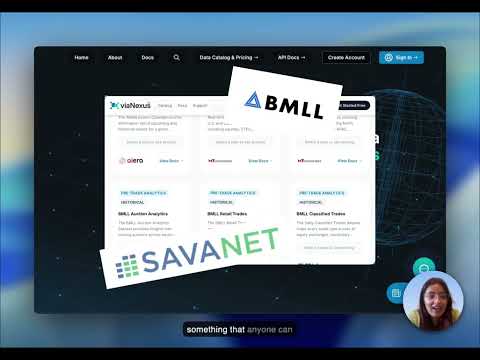
Live Market Dashboard & Death Cross Alert
30+ datasets, OpenBB workspace, Paygentic billing, in minutes.
Latest from the blog
View all →Financial Data: A New Stack Is Emerging
Building dashboards and AI agents on 30+ institutional datasets through one API.
Reinventing Fundamentals: Standardization, Done Properly
How viaNexus + SavaNet turned XBRL chaos into structured financial schema.
Building an Earnings Season Navigator
Combining six viaNexus datasets into one earnings dashboard.
viaNexus + MCP = The Easy Button for AI
How MCP makes financial data accessible to any AI agent.
Start building.
14-day free trial. No credit card. Connect to 30+ financial datasets through your AI in under two minutes.
Or jump to the MCP quickstart if you already have an account.