
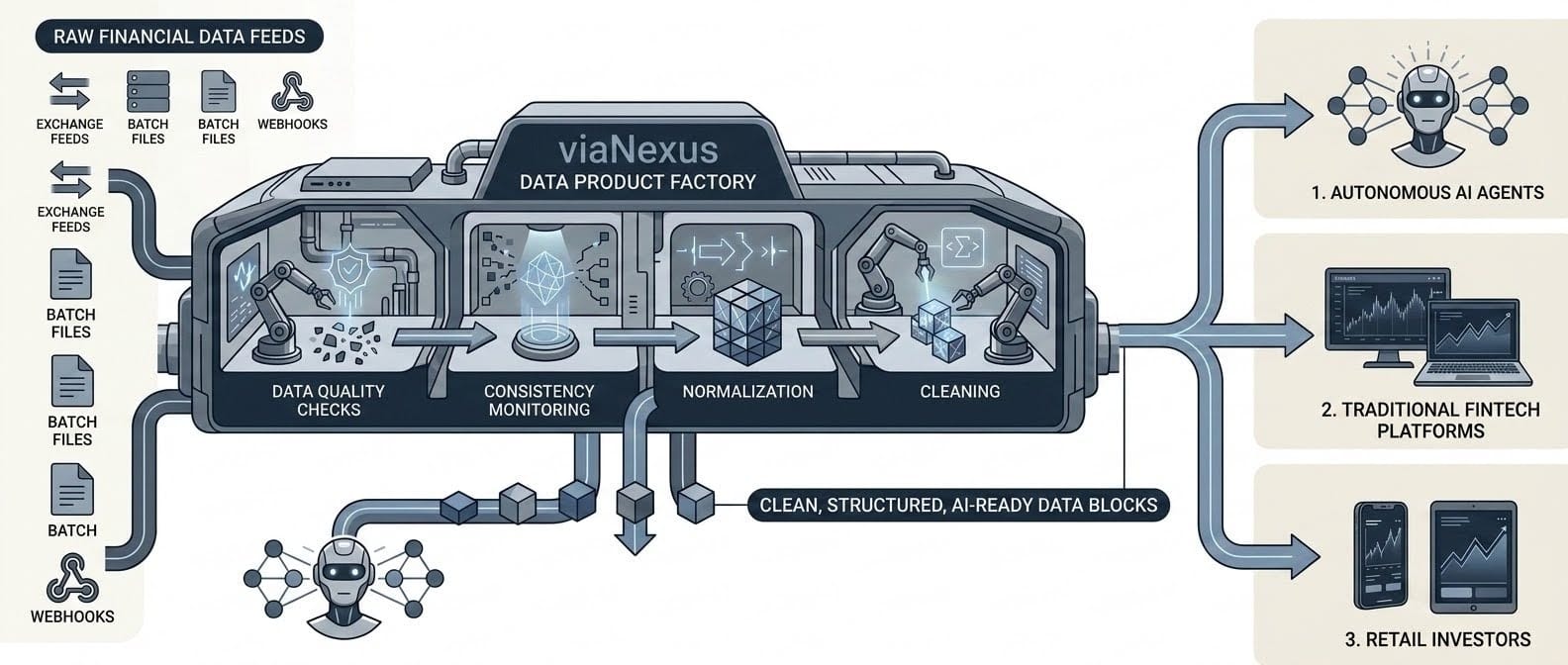
A regional exchange is sitting on something people would pay for. Every trade that crosses its book, every quote, every corporate action, is data somebody downstream wants.
Most of them sell almost none of it directly. Not because the demand is missing, but because the distance between a raw multicast feed and something a developer can buy with a credit card has always been measured in years and millions of dollars. So the feed goes to an aggregator instead, and the aggregator keeps the customer.
That trade-off is now breaking down. The $40 billion global financial data industry has reached a tipping point: as capital markets move from human-driven terminals to autonomous, agent-driven workflows, the demand for structured, low-latency, contextually grounded data has climbed sharply, while the tooling required to package and deliver it has stayed complex and expensive. Exchanges, market makers and independent providers are all facing the same structural shift at once.
Historically, regional financial exchanges and market makers have sat on mountains of valuable raw data but shied away from commercializing it. The sheer effort to produce discernible, digestible, and reliable market data products required specialized expertise, multi-year development cycles, and millions of dollars in infrastructure costs.
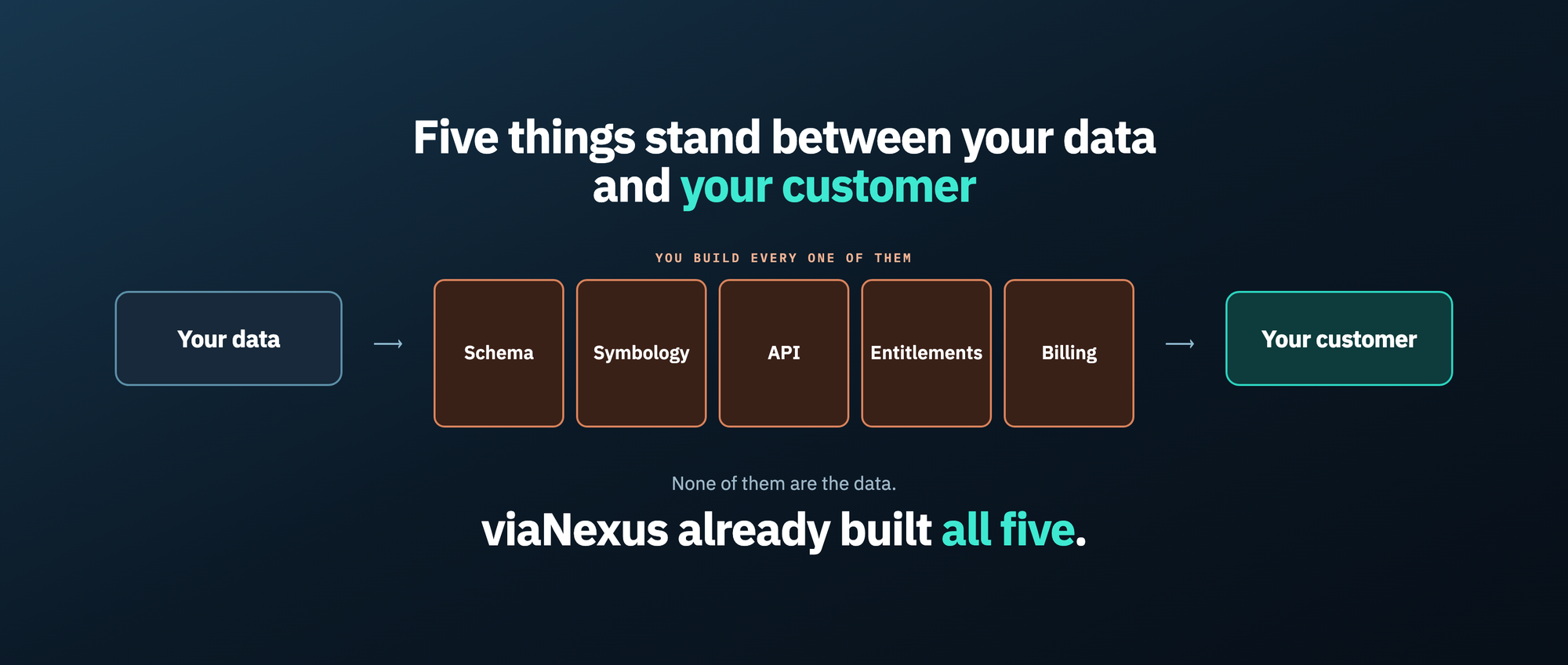
That is precisely where viaNexus enters the picture. It is built on production infrastructure originally acquired from the US exchange IEX. viaNexus has since rebuilt it for performance and broken it into modules, so the work of productizing and monetizing data moves off the provider and into the platform. By embedding these capabilities directly into a modular platform—deployable across public cloud environments, on-premises systems, or secure private clouds—it significantly lowers operational expenditures, removes integration bottlenecks, and dramatically accelerates time-to-market.
The Legacy Monolith: Why Market Data Commercialization Was Broken
Traditionally, distributing financial data meant facing three critical barriers:
- Astronomical Engineering Overhead: Building a modern API platform, an entitlement engine, and a billing stack from scratch is a massive undertaking. Exchanges were forced to spend valuable engineering capacity on infrastructure plumbing rather than core product innovation.
- Loss of Control to Intermediaries: Because direct distribution was too complex, exchanges historically handed over their raw feeds to legacy aggregators (such as Bloomberg and Refinitiv). These aggregators marked up the data, controlled the client relationships, restricted pricing flexibility, and captured the lion's share of the profit margins. Retail investors lacked viable options; despite LLMs making financial analysis easily accessible, acquiring reliable, entitled market data remained impossible at an affordable price point.
- The Consumption Divide: On the buy-side, data consumers had to map, normalize, and cache every single feed independently. B2B licensing was rigid, minimum subscription fees were high, and instant, self-service developer access was virtually nonexistent.
By taking a platform-centric approach, viaNexus bridges this divide, giving exchanges a "product factory" to package, license, and monetize their data directly with zero friction.
Under the Hood: The Complex Event Processing (CEP) Engine
Removing that burden only works if the thing underneath it can carry the load.
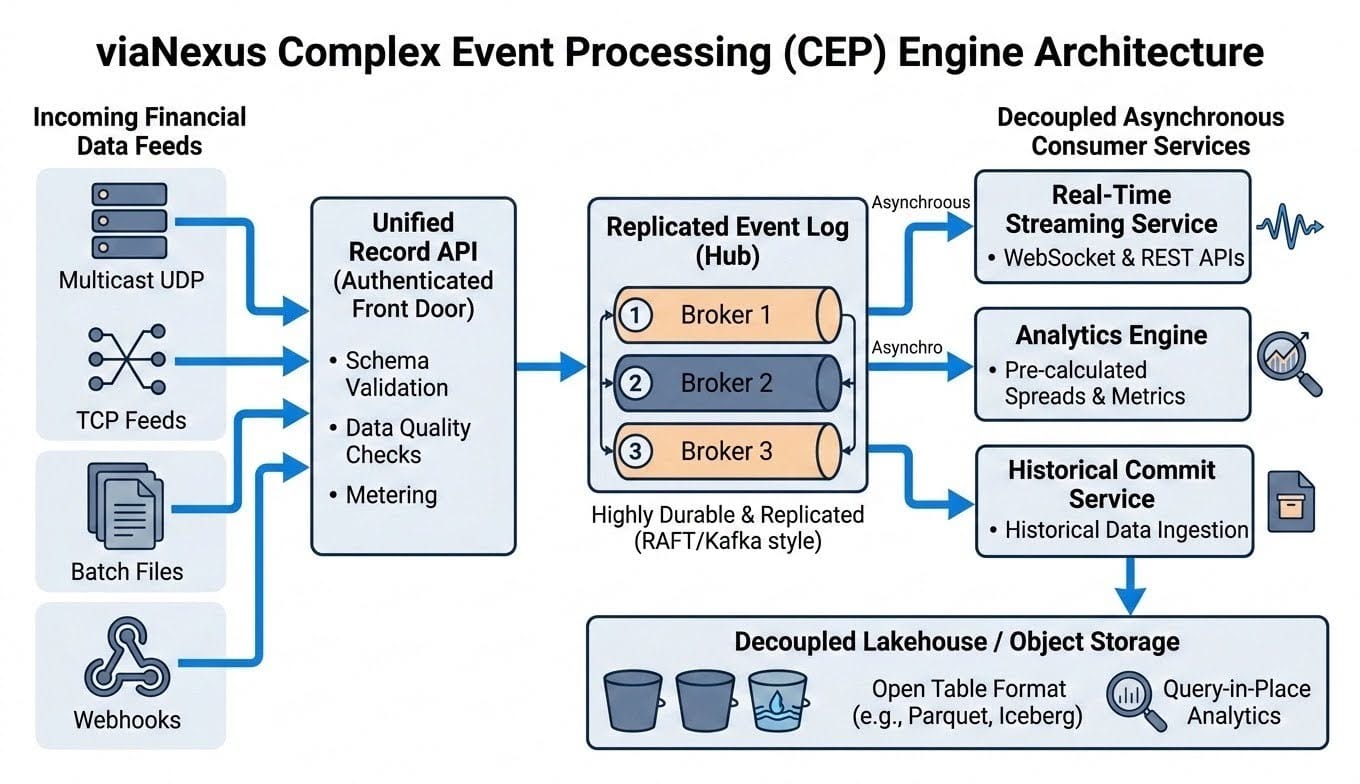
At its core, the viaNexus platform is designed as an event-driven, language-agnostic architecture optimized for high performance, scale, and resilience.
- High-Throughput, Ultra-Low Latency Ingestion: The platform is built to ingest real-time market data (such as raw multicast UDP or TCP exchange feeds) at high transaction rates exceeding 1 million transactions per second, maintaining sub-3ms latency for raw feeds and sub-250ms latency across normalized REST and WebSocket streaming APIs.
- Unified Write Path: Every feed, batch file, or third-party webhook enters the platform through a single, authenticated write API (the Record API). This single front door handles schema validation, data quality checks, de-duplication, and metering.
- The Replicated Event Log: Rather than writing directly to storage, the ingestion layer publishes all incoming records to a highly durable, replicated event log (replicated across three brokers). Independent consumer services (like real-time streaming, historical commit, or analytics engines) read from this log asynchronously. This ensures that a heavy query or ingestion load never degrades customer performance.
- Decoupled Lakehouse Storage: Historical data is written in an open table format on regionally redundant object storage, allowing storage and compute to scale independently and ensuring data remains accessible for query-in-place analytics.
Ontology & Semantics: Eliminating Contextual Confusion
Throughput solves speed. It does not solve meaning.
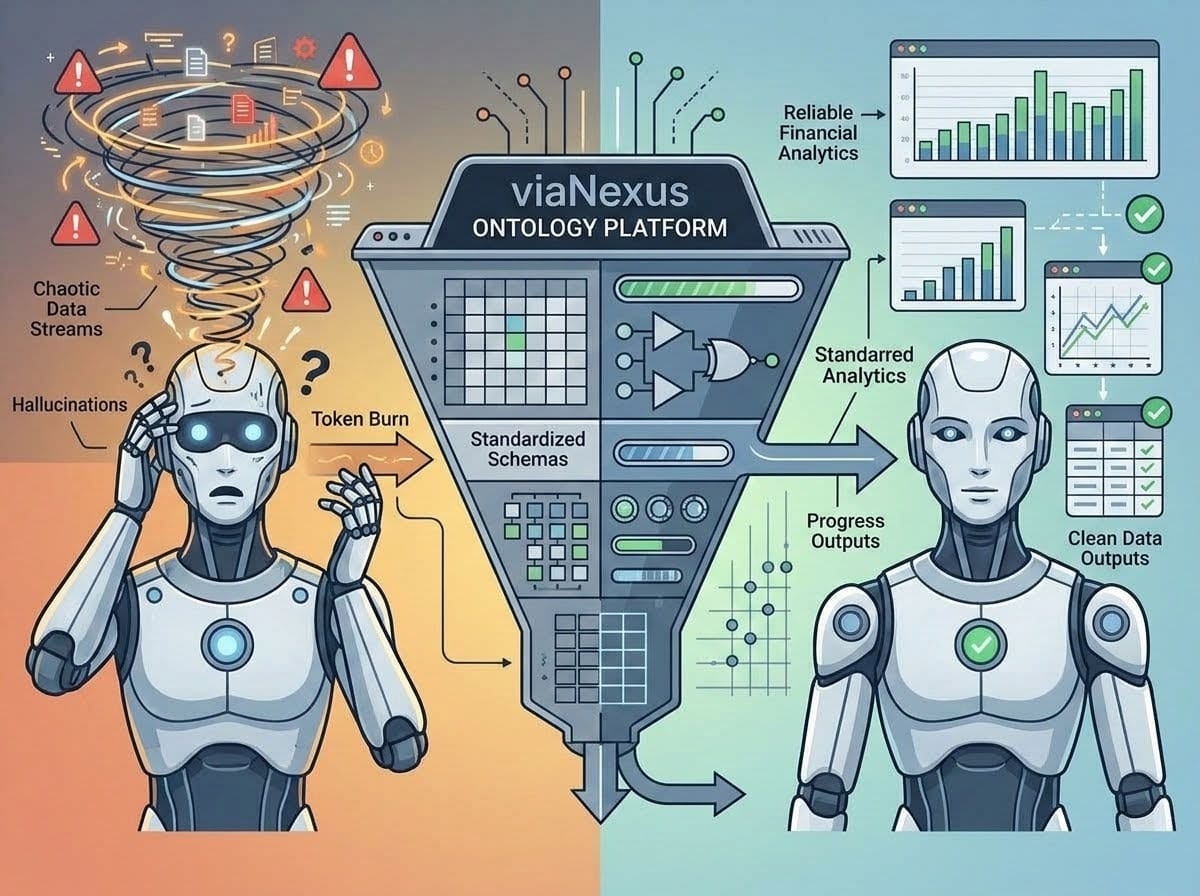
A common flaw in financial data distribution is the siloing of context. When a user or application interacts with a dataset, minor misalignments in symbology or metadata can lead to costly errors.
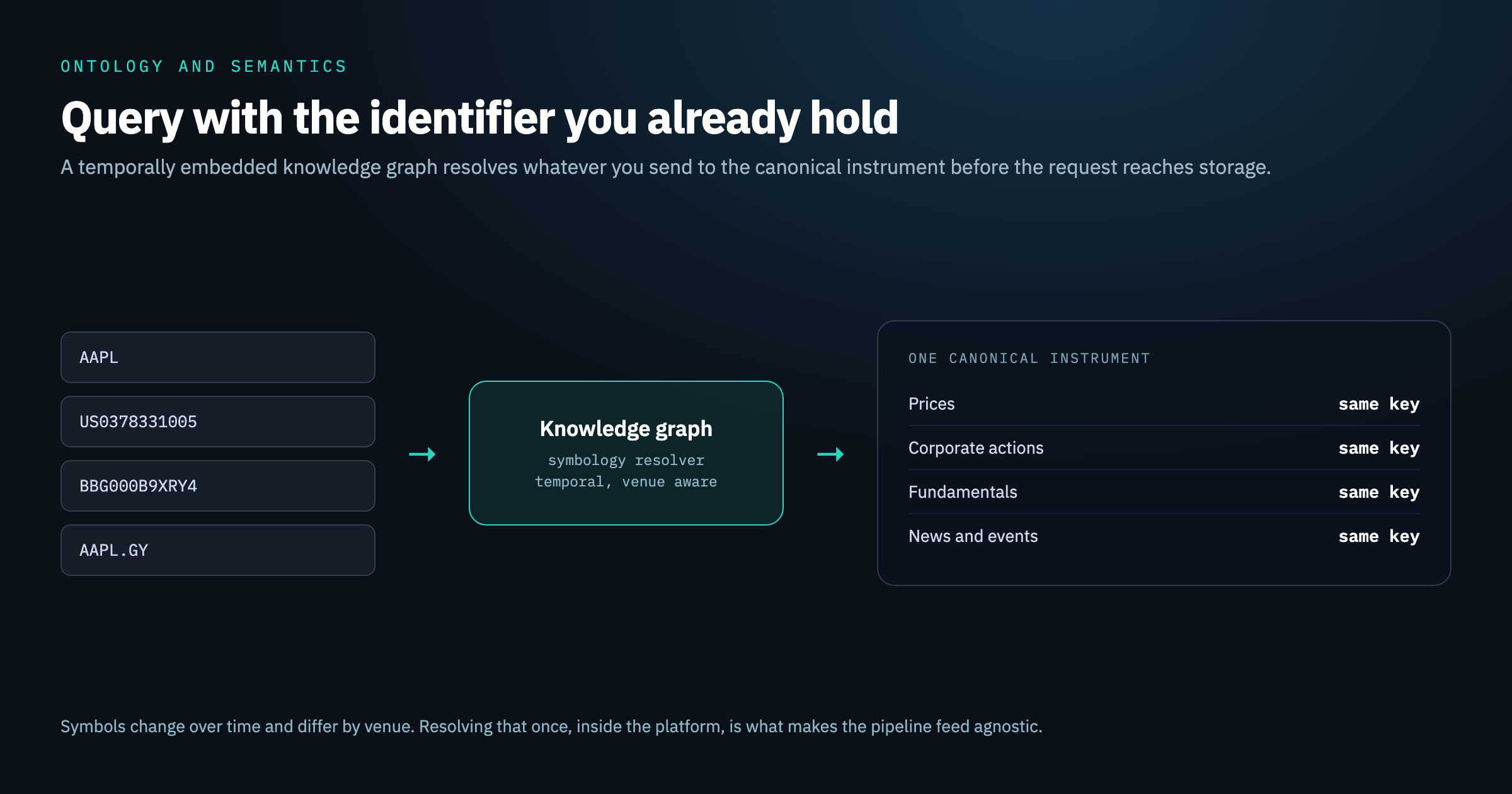
To solve this, viaNexus maintains a strict, standardized ontology and metadata structure across the entire platform. Whether a consumer is working with real-time streaming ticks, company fundamentals, or corporate actions, the semantic relationship between data points is maintained natively.
On the read path, a built-in Temporally Embedded Knowledge Graph acts as a symbology resolver. Instead of forcing clients to learn complex internal venue-specific codes, temporal evolution of a symbol, they can query using whatever identifier they already hold (e.g., Symbol, ISIN, or Figi). The platform maps the request to the canonical instrument identifier before reaching storage. This makes the ingestion and query pipeline completely feed-agnostic.
AI-Native by Design: Solving Hallucinations and Token Burn
That consistent view of an instrument matters most to the consumer arriving fastest: the model.
Generative AI and Large Language Models (LLMs) are rapidly becoming the dominant consumers of market data. However, standard LLMs struggle with financial data for three reasons: they confidently fabricate facts (hallucination) due to stale weights or unreliable web scraping; they consume massive amounts of context window (token burn) when forced to reason over un-normalized data; and they lack secure, entitlement-aware access controls.
The viaNexus Agentic Services Technology (vAST) represents a paradigm shift in financial AI. Delivered natively alongside the low-latency APIs, vAST includes:
- Model Context Protocol (MCP) Server: A secure server enabling immediate connectivity for any MCP client (like Claude, Cursor, or custom setups) using a single signed software credential.
- Embedded Entitlements: Entitlements are evaluated on every single request, rather than once per session. This ensures that autonomous agents cannot violate compliance rules or access unlicensed datasets.
- Hallucination-Free Workflows: By anchoring the LLM's requests to normalized, pre-calculated analytics (such as VWAP, moving averages, or spreads) delivered in real-time, the platform eliminates the need for the model to do math in context or rely on outdated web data.
- Reduced Token Burn: vAST prevents "MCP spaghetti" and continuous polling loops. Agents can register triggers and go to sleep; the platform's CEP engine monitors the feeds and pushes structured, semantic alerts to wake the agent only when specific conditions are met.
Three Deployment Models to Scale
None of this helps a provider who cannot get it in the shape their business needs.
To maximize reach and address different market segment needs, the same underlying platform is offered in three distinct ways:
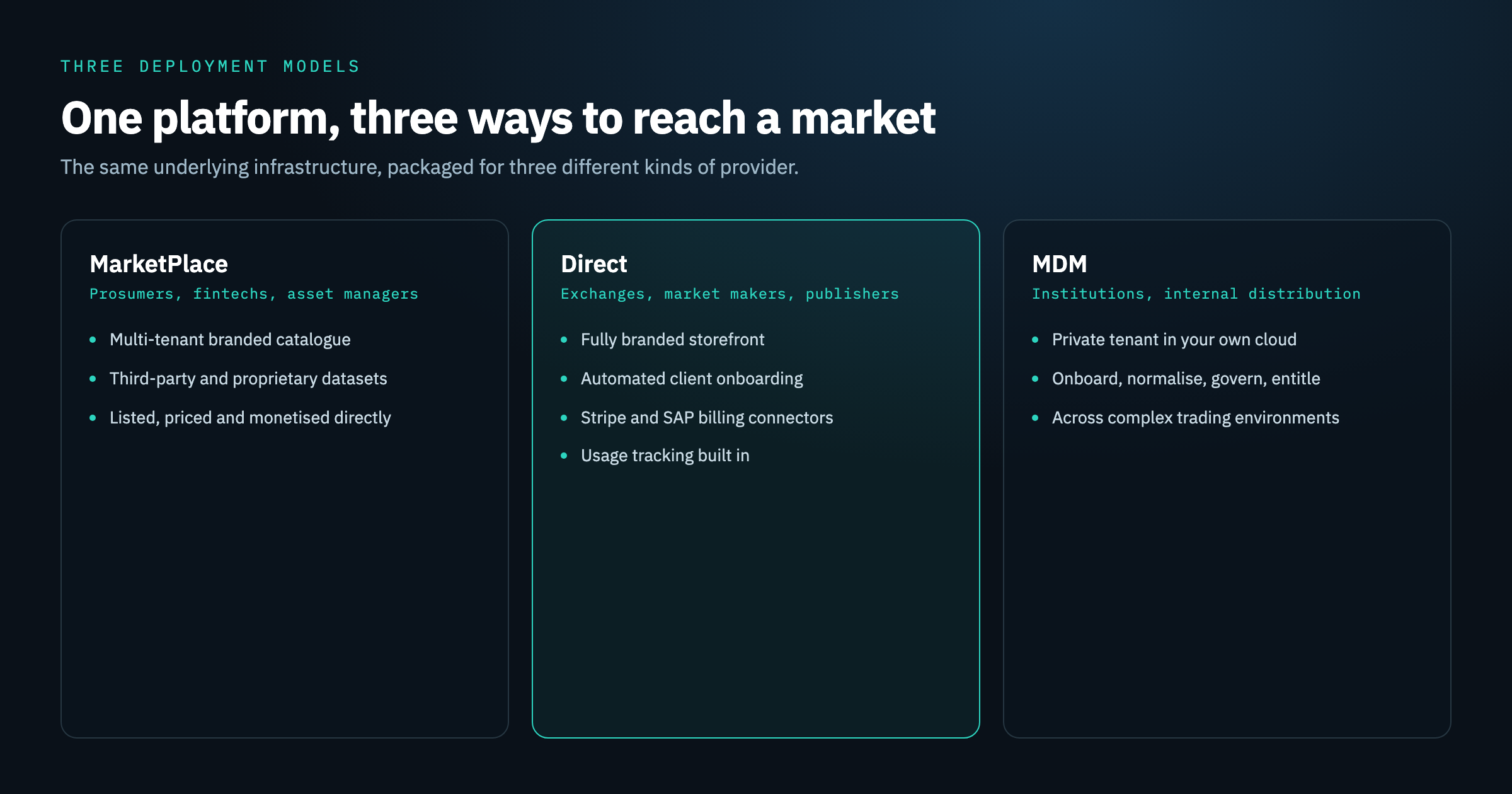
- viaNexus MarketPlace: A multi-tenant, branded catalog where third-party and proprietary datasets are listed, priced, and monetized directly for prosumers, fintechs, and asset managers.
- viaNexus Direct: A white-labeled "monetization-as-a-service" platform built specifically for exchanges, market makers, and publishers. It includes a fully branded storefront, automated client onboarding, usage tracking, and e-commerce integrations (e.g., Stripe payments and SAP billing connectors).
- viaNexus MDM (Market Data Management): A secure, private-tenant instance deployed within an institution's private cloud (such as Google Cloud or Beeks co-location) to onboard, normalize, govern, and entitle data internally across complex trading environments.
Proven in Production: The SIX Group Landmark Partnership
All of which is a claim until somebody runs it in production.
The ultimate validation of viaNexus's model is its deployment with SIX Group (the Swiss Exchange). SIX needed to make its data more accessible to a broader ecosystem of developers and fintechs while reducing startup costs and operational complexity.
Instead of a multi-year build, viaNexus deployed a fully white-labeled version of the platform—brand-named "Market Signal"—which went live in July 2026 for private beta and launched fully on September 8, 2026.
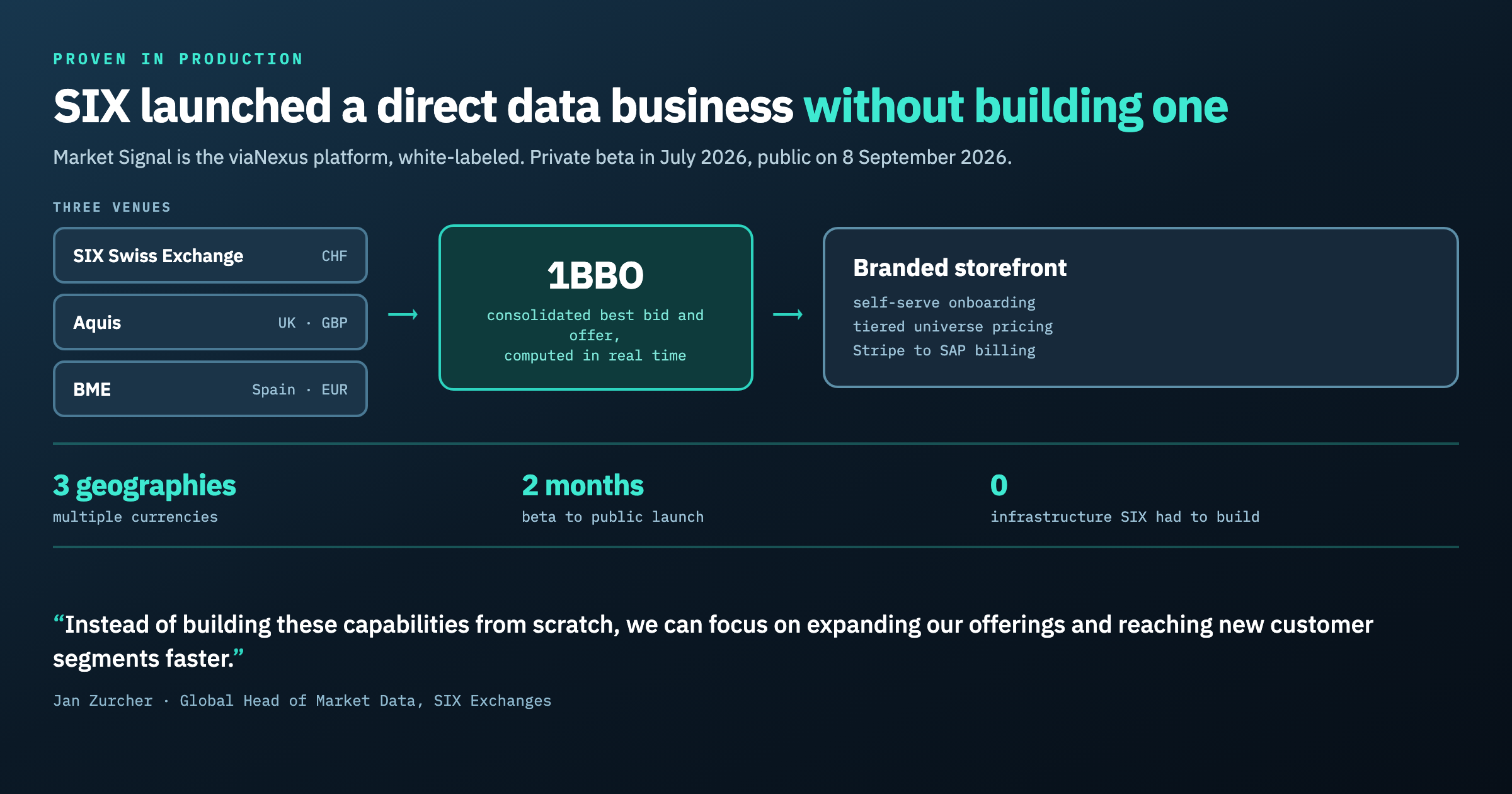
The SIX deployment showcases the platform's agility:
- Multi-Venue Consolidation: Integrates market data from three venues across three geographies (SIX Swiss Exchange, Aquis UK, and BME Spain) in multiple currencies.
- Unified Products: Computes a consolidated Best Bid and Offer (1BBO) in real-time by capturing ticks, enriching them, and republishing them dynamically.
- Fully Automated Commercials: Powers an e-commerce site with self-service client onboarding, tiered universe-based pricing, and automated Stripe-to-SAP billing connectors.
Jan Zurcher, Global Head of Market Data at SIX Exchanges, noted: "Instead of building these capabilities from scratch, we can focus on expanding our offerings and reaching new customer segments faster, while relying on viaNexus' technology, expertise, and execution to bring this new distribution model to market efficiently."
Conclusion: The Direct GTM Future
The financial market data industry is shifting rapidly. The era of rigid terminal licenses and complex data procurement is giving way to affordable, API-first, and AI-ready data streams.
With viaNexus, exchanges no longer have to design custom schemas, maintain complex API connections, or build billing stacks from scratch. By shifting the complexity from the data provider into the platform, viaNexus empowers financial institutions to take back control of their data products, launch direct-to-consumer services in months instead of years, and capture higher margins in an increasingly competitive world.
If you are an exchange, market maker or publisher, contact us about what a deployment involves.
Start a free trial, browse the data catalog and API docs, add the connector in Cursor or Claude, and describe what you want to build.